
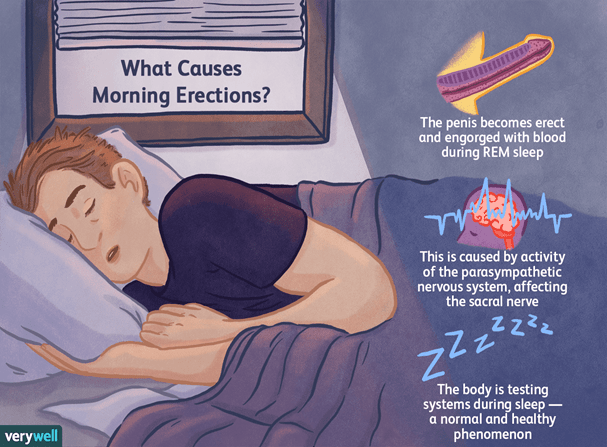
THE MALE AND MORNING ERECTION.
“Is not having an early morning erection a sing of erectile dysfunction or sexual weakness?”
As a health care professional, that has been one of the questions I have got to answer most from my male patients or friend, and even some females.
In this write up, I am going to answer that question in detail, beginning from letting you know exactly what morning erection is and why it even occurs in the first place.
An Overview Of What Morning Erection Is.
The morning penile erection, or as it is medically known, “nocturnal penile tumescence”, is not only an interesting physiological phenomenon, it can also tell us a lot about a patient’s sexual function. It affect all males, even males in the womb and male children. It also has a female counterpart in the less frequently discussed nocturnal clitoral erection.
Men of all ages can experience nocturnal penile tumescence (NPT). It’s healthy at any age and is a sign of a properly functioning blood and nervous system in and around the penis. NPT may also occur in men in their 60s and 70s. It will become less frequent as ED (erectile dysfunction) issues begin to occur, and those issues become more frequent with age.
Men may experience an erection three to five times each night. Unrelated to what’s in your dreams, NPT can last up to and even longer than 30 minutes. Some men may experience an erection as long as two hours during their sleep. Most erections will ease within a few minutes of waking up. There are situations where it lasts longer than four hour. Though rare, when it occurs, medical attention is inevitable (priapism).
Morning wood is a slang term for NPT. This occurs when someone with a penis gets an erection in the middle of the night or the early morning hours while they are sleeping. If you have morning wood, you may often wake up with an erection. Another name for morning wood is morning glory.
Men are able to have sex with these erections, which may have the benefits of enabling sexual excitation, couples resolving marital conflicts, and their partners getting involved.
What causes erections (physiology).
“Morning glory” or penile erections occur in response to complex effects of the nervous system and endocrine system (the glands that secrete hormones into our system) on the blood vessels of the penis, that is to say, morning erections have been connected to some hormones and neurotransmitters.
Hormonal
When sexually aroused, a message starts in the brain, sending chemical messages to the nerves that supply the blood vessels of the penis, allowing blood to flow into the penis. The blood is trapped in the muscles of the penis, which makes the penis expand, resulting in an erection.
Several hormones are involved in influencing the brain’s response, such as testosterone (the main male hormone), and prolactin, also known to be crucial for the development of reproductive and sexual behaviors. It stimulates an array of testicular functions in males and ovarian functions in females
Your testosterone level is at its highest in the morning after you wake up. It is highest immediately after waking up from rapid eye movement sleep (REM; to be discussed in another write-up) stage. The increase in this hormone alone may be enough to cause an erection, even in the absence of any physical stimulation. As men get older, usually between ages 40 and 50, natural testosterone levels begin to fall. As this level decreases, episodes of nocturnal penile tumescence (NPT) may decrease as well.
This same mechanism can occur without the involvement of the brain, in an uncontrolled reflex action that is in the spinal cord. This explains why people with spinal cord damage can still get erections and why you can get erections when not sexually aroused.
Nervous stimulation.
Penile erection is neurologically controlled by the autonomic nervous system. Several neurotransmitters, especially norepinephrine and acetylcholine, are well-known regulators of penile erection. Nocturnal penile erections occur during Rapid Eye Movement (REM) sleep (the phase during which we dream). They occur when certain areas of the brain are activated. This includes areas in the brain responsible for stimulating the parasympathetic nerves (“rest and digest” nerves), suppressing the sympathetic nerves (“flight and fight” nerves) and dampening areas producing serotonin (the mood hormone).
Sleep is made up of several cycles of REM and non-REM (deep) sleep. During REM sleep, there is a shift in the dominant system that’s activated. We move from sympathetic (fight and flight) stimulation to parasympathetic (rest and digest) stimulation. This shift in balance drives the parasympathetic nerve response that results in the erection. This is spontaneous and does not require being awake. The erections are not related to erotic content of dreams, previous sexual activity, or a full or empty bladder. Oddly enough, the erections have generally been considered as mere epiphenomena of REM sleep-related physiologic changes.
There are two types of erections. One is a psychogenic erection which occurs due to the stimulation of some parts of the brain, and the other is reflex erection which may spontaneously appear at any time, such as NPT. A psychogenic erection is triggered by sexual stimulation and sexual arousal.
What does it mean when it is absent?
Erections are considered a normal part of sleep physiology in men. Evaluation of NPT is one of the earlier tests devised to study erectile dysfunction (ED), thus, loss of nocturnal erection can be a useful marker of common diseases affecting erectile function. One example is in diabetics where the lack of morning erections may be associated with erectile dysfunction due to poor nerve or blood supply to the penis. In this case, there’s a poor response to the messages sent from the brain during sleep which generate nocturnal erections.
It is thought nocturnal erections can be used as a marker of an anatomical ability to get an erection (a sign that the essential body bits are working), as it was thought to be independent of psychological factors that affect erections while awake. Studies have suggested, however, that mental health disorders such as severe depression can affect nocturnal erections. Thus its absence is not necessarily a marker of disease or low testosterone levels.
The frequency of morning erections and erection quality has also been shown to increase slightly in men taking medications for erectile dysfunction such as Viagra.
So is all this morning action good news?
While some men will put their nocturnal erections to good use, many men are not aroused when they have them and tummy sleepers might find them a nuisance.
Since good heart health is associated with an ability to have erections, the presence of nocturnal erections is generally accepted to be good news. Maintaining a healthy lifestyle is important in avoiding and even reversing erectile dysfunction, so it’s important to remember to eat healthily, maintain a healthy weight, exercise and avoid smoking and alcohol abuses.
 W.PROSPER.N's BLOG